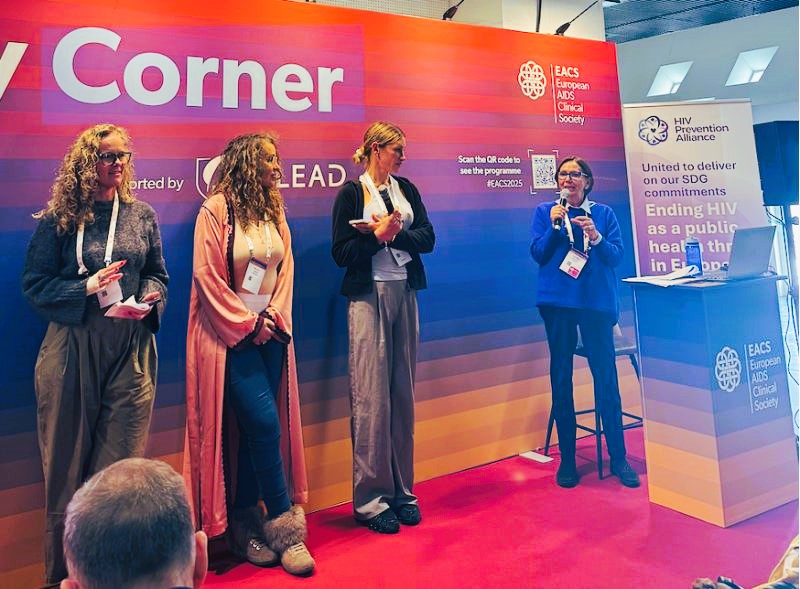
The European AIDS Conference is a strategic event for sex workers' rights activists. This is where we advocate for access to PrEP, build alliances at the intersection of sex worker's rights and the rights of People Living with HIV, and bring visibility to our movement. As sex workers are recognised as one of the key populations whose involvement is essential in curbing HIV transmissions, ESWA makes a point of using this platform to bring more awareness to the challenges our community faces in accessing HIV prevention.
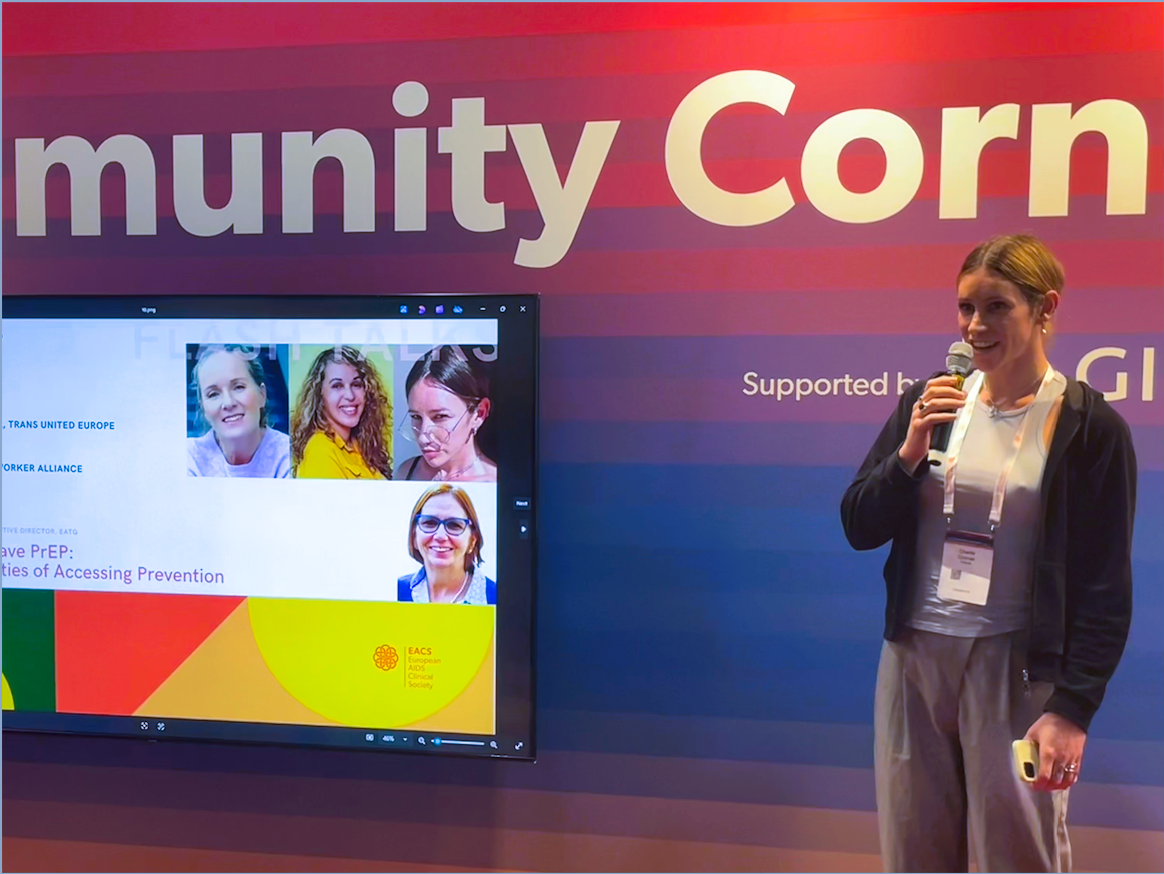
ESWA Board Member Charlie Cosnier dazzled the community corner with her passionate "Girls Just Want to Have PrEP!" speech
This year, our representant was Charlie Cosnier - Board Member of ESWA and FLIRT - Front Transfem, a mutual support collective of transfem people facing precarious lving conditions.
In the community corner of the conference, Charlie shared her personal experience, bringing much needed attention to how lack of access to housing and trans-specific medical information can make staying on PrEP nearly impossible:
Girls just want to have PrEP!
At FLIRT, we’ve been facilitating access to PrEP since 2020 — mostly for low income trans people, with experience of sex work, migration, and others involved in what medical language still calls “risky sexual practices.”
But for our organisations, PrEP is never just about one pill. It’s about the whole ecology around it — housing, hormones, mental health, language, safety, and trust.
Many of us, including myself, have been using PrEP for years — in my case, for about ten. So we’ve seen very concretely what works and what doesn’t.
The main barriers we see are not about refusing care — they’re about not knowing PrEP is for you. Many trans people have no idea PrEP even applies to them, because prevention messages don’t target them. And even when we do know about PrEP, we rarely find clear information about how PrEP interacts with hormones for instance, or what scheme a trans person should take when they need to use PrEP on demand, the “man scheme” or the “woman scheme” …
That’s why peer-led workshops are so central in our work. We talk about sexual health inside the same spaces where we talk about hormones. People come for one topic, but they stay for another — they come to learn how to inject estrogen safely for instance, and they leave with information about HIV prevention, STI testing, or doxyPEP.
These workshops often become the first point of entry into the health system. Many of our participants meet a peer health mediator, or are redirected to a trained health professional for the first time through those sessions.
But all of this relies on stability.
And when you don’t have a place to sleep, or when you’re using drugs to manage trauma, or when your mental health is spiraling, taking a daily medication easily falls off the list.
PrEP is not in the survival kit when you’re couch-surfing. You might even have the pills in your bag — but you won’t have the continuity that makes it effective.
Housing sits at the bottom of our survival pyramid — it’s the base on which everything else is built. You can attend medical appointments, yes; but those efforts collapse quickly if housing isn’t addressed.
Another insight from barriers: between hormones and HIV medicine, hormones usually come first — because not passing, or facing street violence, feels like a more immediate threat than a virus.
We’ve seen people stop HIV treatment to prioritize hormones. Not because they “don’t care” about prevention, but because no one was able to provide them with the right information about interactions, and they were literally choosing between social death and biological risk — and that’s a choice no one should ever have to make.
Migration adds another layer of complexity.
Language barriers, administrative barriers, no social security coverage.
That’s where peer-led structures like FLIRT become vital: we can identify who is most at risk, translate, accompany, and deliver medication directly when needed. It’s not charity; it’s life-saving logistics.
But we can’t do that sustainably on short-term or project-based funding.
We need flexible, long-term funding that recognizes community organizations as partners, not tokens.
We need our therapeutic education programs to be funded — because they’re the bridge between marginalized people and the healthcare system. They create trust where medicine alone cannot.
And we need our research and data collection to be recognized and supported — because the data we produce on patient experience, on barriers, on informal care, does not exist anywhere else. It should inform national strategies and improve clinical practices, not just fill a footnote in a report.
So when we talk about “HIV alliances,” it’s important that community organizations are not treated as symbolic representatives, but as dispensers of care, co-producers of knowledge, and equal partners in the design and evaluation of programs.
Thank you for taking the time to read this.
Your support means the world to us!